Latest Spheroidizing Techniques for Modern Ductile Iron Foundries
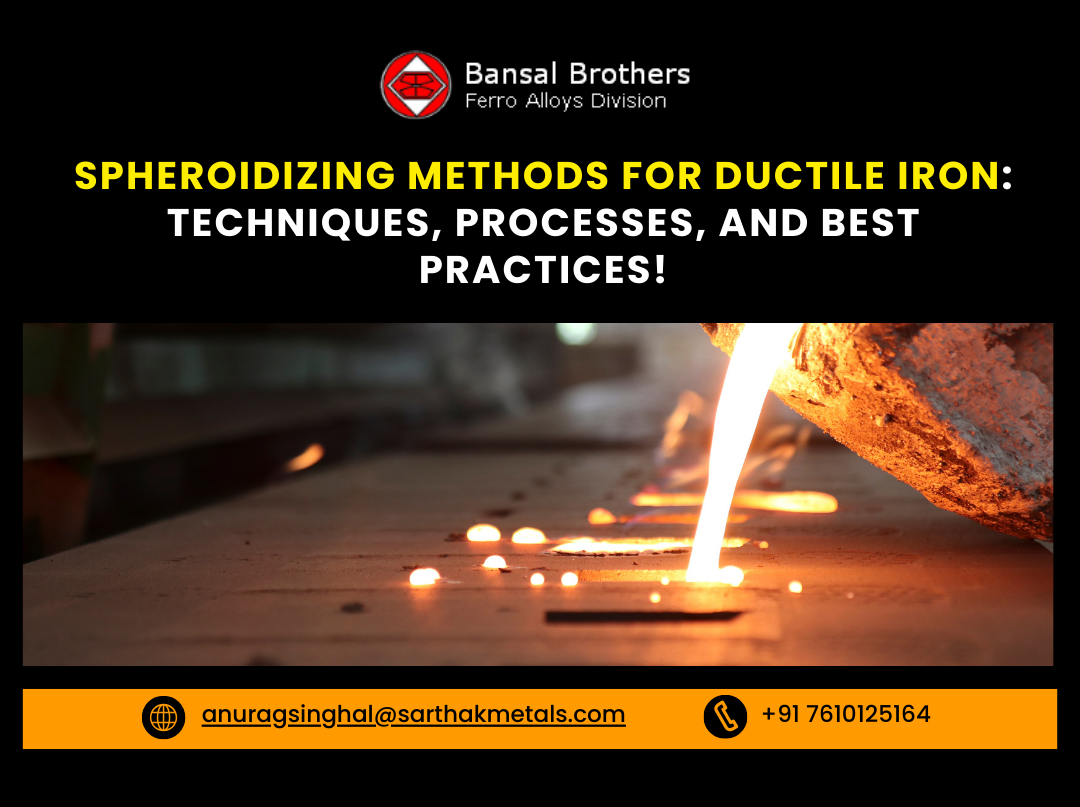
In today’s competitive casting industry, producing high-quality ductile iron (DI) requires more than just melting metal and pouring castings. Foundries are under constant pressure to deliver stronger, lighter, defect-free, and cost-effective components. At the heart of ductile iron production lies a critical step that determines final performance: spheroidization methods for ductile iron.

Bansal Brothers, a trusted name in the ferro alloy industry, has been providing advanced ferro silicon magnesium solutions and expertise to ensure superior ductile iron quality for steel plants, foundries, and industrial customers worldwide.
Spheroidization is the process that transforms flake graphite into spheroidal (nodular) graphite, giving ductile iron its excellent mechanical properties such as high tensile strength, improved ductility, fatigue resistance, and machinability. Modern spheroidizing techniques are now more controlled, safer, and highly efficient compared to traditional methods, helping foundries meet tighter quality and productivity demands.
Why Spheroidizing Is the Backbone of Ductile Iron Quality
Unlike grey iron, which contains flake-shaped graphite that weakens the structure, ductile iron contains rounded graphite nodules that prevent crack propagation and improve strength and toughness.
Without proper spheroidization, ductile iron can suffer from:
Low tensile strength
Poor elongation
Inconsistent microstructure
Shrinkage and porosity defects
High rejection rates
That is why modern foundries invest heavily in advanced spheroidizing technologies to ensure consistency, safety, and high productivity.
1. Advanced Ladle Treatment Techniques
Ladle treatment remains one of the most widely used Spheroidizing Methods For Ductile Iron, but modern techniques have been significantly refined.
Key Improvements:
Use of covered treatment ladles
Optimized reaction chamber design
Precise magnesium recovery calculation using ferro silicon magnesium
Controlled temperature and turbulence
Benefits for Customers:
Higher and more consistent nodularity
Reduced slag formation and magnesium losses
Stable mechanical properties across batches
Bansal Brothers provides premium-grade ferro silicon magnesium alloys to ensure ladle treatments are highly efficient, helping foundries produce consistent, high-quality ductile iron.
2. Sandwich Method with Enhanced Process Control
The sandwich method is one of the most reliable and commonly used spheroidizing techniques in modern foundries.
What’s New:
Precision placement of magnesium alloy at the bottom of ladle
Optimized cover material ratios
Controlled metal pouring rates
Digital temperature monitoring
Why Customers Benefit:
Reduced violent reactions
Improved safety
Higher magnesium utilization
Fewer surface defects and blowholes
This method is widely adopted by foundries supplying automotive, agricultural, and engineering components, where consistency is crucial.
3. Tundish Cover Spheroidizing (TCS) System
The Tundish Cover System is one of the most advanced and automated spheroidizing techniques used in high-volume modern foundries.
How It Works:
Magnesium treatment alloy is placed in a closed tundish chamber positioned between the ladle and the mold. As molten iron flows through, spheroidization occurs under controlled conditions.
Key Advantages:
High magnesium recovery
No violent reaction
Low smoke and fume emission
Excellent process repeatability
Ideal for automated production lines
Customer Advantage:
TCS-treated ductile iron offers cleaner metal, better surface finish, reduced rejections, and superior mechanical properties, making it perfect for critical components such as automotive engine parts and pressure-bearing components.
4. In-Mold Spheroidizing Technique
In-mold spheroidizing is a space-saving and cost-efficient method where magnesium treatment occurs inside the mold gating system.
Key Features:
Magnesium alloy placed in a reaction chamber inside the mold
Spheroidization happens as iron flows during pouring
No separate ladle treatment required
Benefits:
Lower magnesium consumption
Reduced oxidation losses
Safer working environment
Ideal for smaller and medium-sized castings
Customer Value:
This method is highly suitable for jobbing foundries and batch production, offering cost savings without compromising on ductile iron quality.
5. Wire Injection Spheroidizing Technology
A revolutionary spheroidizing method used in modern foundries is Cored Wire Injection.
How It Works:
A magnesium-filled wire is injected directly into the molten iron bath using automated equipment, ensuring precise magnesium dosage.
Advantages:
100% process control
High magnesium recovery
No violent reactions
Reduced fume and slag formation
Optimal treatment for every heat
Customer Value:
Foundries using Cored Wire Injection produce uniform, high-nodularity ductile iron with consistent chemical composition, superior mechanical properties, and minimal defects—ideal for export-quality castings.
Bansal Brothers supplies premium cored wires and ferro silicon magnesium alloys to ensure this process delivers maximum efficiency and consistent quality.
6. Smart Magnesium Alloy Selection
Modern spheroidization also depends on choosing the right magnesium alloy and inoculant.
Latest Trends:
Low-rare-earth magnesium alloys
Silicon-magnesium-ferro blends
Special formulations for low sulfur iron
Benefits:
Improved graphite nodularity
Reduced magnesium fade
Consistent mechanical properties
Cost-efficient production
Bansal Brothers offers a full range of Ferro Silicon Magnesium products to meet modern foundry requirements, ensuring stable, high-quality ductile iron for every batch.
7. Digital Process Monitoring & Automation
Modern foundries are adopting Industry 4.0 technologies to monitor spheroidization in real time.
Key Smart Features:
Online temperature sensors
Magnesium recovery software
Automated Cored Wire Injection systems
Digital nodularity tracking
Customer Benefits:
Zero guesswork
Repeatable casting quality
Faster production cycles
Reduced human errors
Lower rejection rates
Customers get consistent mechanical properties, batch-to-batch reliability, and smoother production timelines.
8. Integrated Inoculation with Spheroidization
Modern spheroidization cannot work in isolation. It must be supported by proper inoculation.
Latest Inoculation Practices:
Stream inoculation during pouring
Ladle inoculation after Mg treatment
Controlled late inoculation
Benefits:
Prevents carbide formation
Improves graphite count
Reduces chill tendency
Enhances surface finish
Customer Advantage:
Better inoculation ensures high machinability, better microstructure stability, and longer tool life during machining.
9. Defect Control Through Modern Spheroidizing
Modern spheroidizing techniques significantly reduce common DI defects such as:
Magnesium fade
Graphite degeneration
Porosity
Shrinkage
Oxide inclusions
How Customers Benefit:
Lower scrap rate
Higher casting acceptance
Reduced machining losses
Improved surface finish
Better fatigue life of components
10. Environmental & Safety Improvements
Traditional magnesium treatment was dangerous, smoky, and polluting. Modern techniques focus on eco-friendly and safe operations.
Safety Enhancements:
Enclosed treatment systems
Dust and fume extraction units
Automated wire feeding
Reduced manual handling
Customer Advantage:
Safer production means uninterrupted supply, fewer delays, stable labor productivity, and better compliance with global safety standards—a big plus for export buyers.
Business Benefits for Customers Using Modern Spheroidized Ductile Iron
From a customer’s point of view, advanced spheroidizing techniques translate into:
Stronger and lighter castings
Consistent mechanical properties
Reduced risk of failures
Longer service life of components
Improved machinability
Cost stability
Better reliability in critical applications
This is why industries such as automotive, construction, agriculture, pipeline, wind energy, and heavy engineering prefer modern DI castings.
Final Thoughts: Why Modern Spheroidizing Is a Game Changer
Spheroidization is no longer a simple metallurgical step; it is a precision-controlled process that defines ductile iron quality.
By using modern spheroidizing techniques, including Cored Wire Injection, Tundish Cover Systems, in-mold treatments, and optimized ladle methods, combined with Bansal Brothers’ high-quality ferro silicon magnesium alloys, foundries can produce high-performance, defect-free ductile iron consistently.
For customers, this translates into better-performing components, lower lifecycle costs, and reliable supply. Partnering with Bansal Brothers ensures access to trusted materials, technical expertise, and process solutions that support modern foundries in delivering excellence.
#BansalBrothers #SpheroidizingMethodsForDuctileIron #CoredWireInjection #FerroSiliconMagnesium

Comments
Post a Comment